Design system strategies
User Experience Writing in design systems allows documentation to move beyond traditional "how-to" guides. User-centric documentation empowers users (designers and developers) to make autonomous, informed decisions by providing documentation that is contextual, adaptive, and goal-oriented, making the design system an active partner in the design process, rather than a static reference library.
Auditing component and pattern documentation
Overview
As part of my work Dell Design System, I led a comprehensive audit of component and pattern documentation. My goal was to ensure every artifact, from foundational components to complex interaction patterns, clearly communicated what the component is, when to use it or its variants, and how it behaves. This work strengthened the system’s usability, reduced ambiguity for designers and engineers, and improved cross‑product consistency.
Approach
1. Establishing evaluation criteria
I created a structured audit framework focused on three pillars:
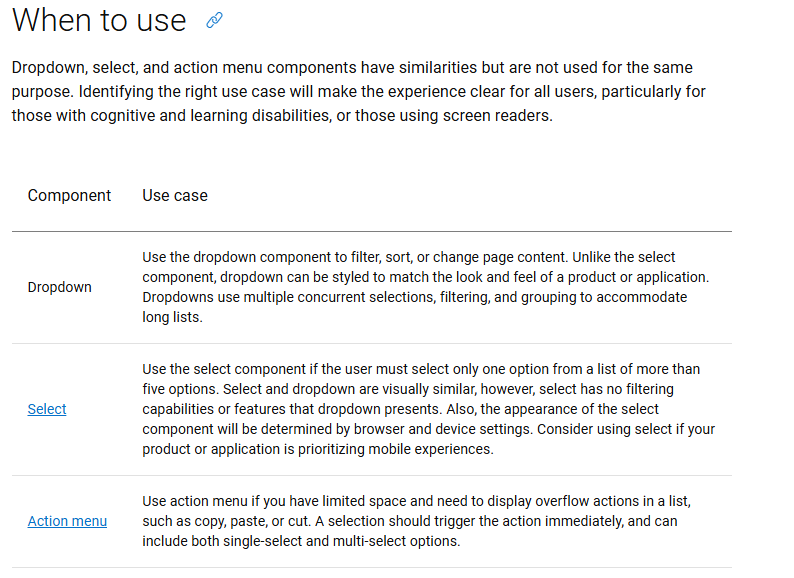
Use Case: Does the documentation clearly explain when and why the component should be used?
Consistency: Does terminology, structure, and guidance align with the rest of the system?
Simplicity: Is the content concise, scannable, and free of unnecessary complexity?
This framework ensured every component was evaluated objectively and consistently.
Approach
4. Aligning with cross‑functional partners
I collaborated closely with design system owners, engineers, and accessibility partners to validate updates. Together, we ensured:
Behavior descriptions matched engineering implementation
Terminology aligned with platform conventions
Accessibility requirements were embedded from the start
This cross‑functional alignment strengthened trust in the documentation.
Outcome
The audit and rewrite improved documentation clarity across the system and user satisfaction by 18%. Teams reported fewer questions about component usage, and engineering saw a decrease in misaligned design handoffs. The system became easier to navigate, easier to contribute to, and easier to scale.
The challenge
Over time, documentation had developed gaps. Some components and patterns followed defined structure and content rules, while others lacked essential guidance. Common issues included:
Missing or unclear use‑case definitions
Inconsistent terminology across components
Overly complex explanations that slowed adoption
Redundant or outdated patterns that confused contributors
These gaps made it harder for teams to design quickly and confidently — and increased the risk of misusing or duplicating components.
Approach
2. Auditing 50+ components and patterns
Using the framework, I conducted a full audit of the design system’s component library. I identified:
Components with overlapping or unclear purposes
Patterns that needed consolidation or retirement
Documentation gaps that hindered adoption
Opportunities to simplify language and reduce cognitive load
This work laid the foundation for a more coherent and maintainable system.
Approach
5. Creating scalable content patterns
To prevent future drift, I developed reusable content templates for component documentation. These templates standardized:
Page structure
Required sections
Terminology
Voice and tone
This ensured new documentation remained consistent and easy to maintain.
Why this work matters
A design system is only as strong as its documentation. By auditing and rewriting component and pattern guidance with a focus on use case, consistency, and simplicity, I helped create a system that empowers teams to design faster, more confidently, and more cohesively.
My role
I owned the content strategy and UX writing approach for the audit. This included evaluating existing documentation, defining quality standards, rewriting content, and partnering with design and engineering to ensure accuracy and alignment.
Approach
3. Rewriting documentation for clarity
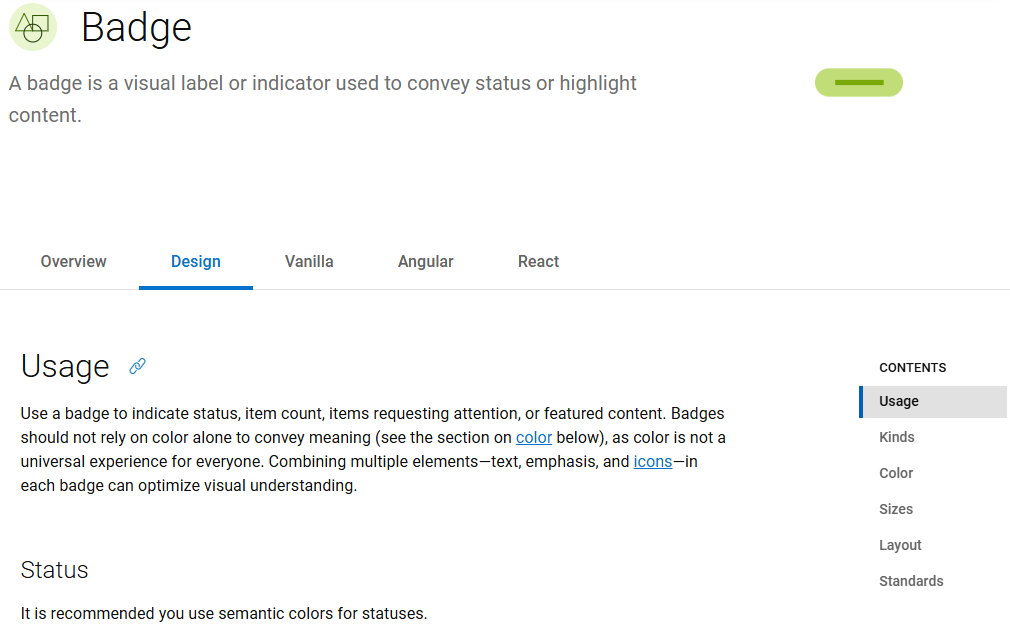
I rewrote component and pattern pages to emphasize decision‑making guidance, not just technical specs. Each page included:
A crisp, plain‑language definition
Clear usage guidelines and anti‑patterns
Behavior notes and interaction expectations
Visual examples paired with concise explanations
This made documentation more intuitive and actionable for designers and engineers.
A scalable contribution model
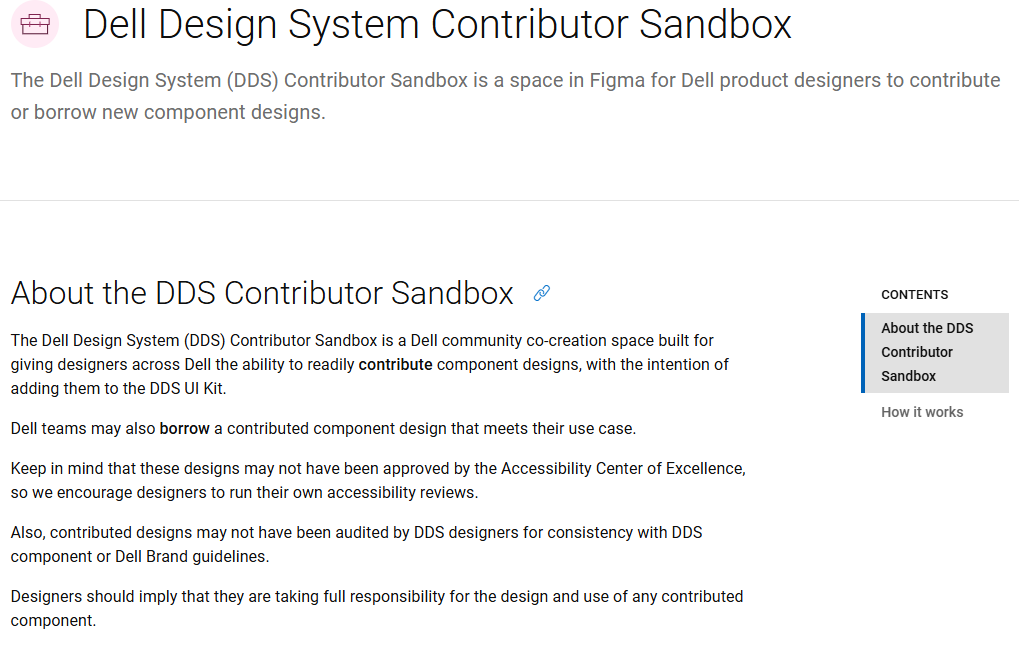
As the content strategist helping to create a scalable model for design contribution across the organization, I was responsible for structuring the communication, documentation, and workflow protocols that govern the submission, and adoption of new components. This project directly addressed the challenge of maintaining a cohesive and relevant design system.
The challenge
Product teams across Dell were moving quickly. Designers were introducing new components at a rate that the design system team could not accommodate. New component and pattern ideas were being backlogged and were rarely added to the design system. This slowed product development, created inconsistencies, and hurt the integrity of the design system team. Without a unified process, the system risked:
Inconsistent or conflicting component usage
Unclear ownership and governance
Slow engineering review cycles
Documentation gaps that hindered adoption
Accessibility violations
To keep the system healthy, we needed a contribution model that was simple, structured, transparent, and scalable across more than 200 designers and engineers.
My role
I owned the strategy, communication, and content architecture behind the contribution model. This included defining the workflow, building the documentation, and ensuring the process was intuitive enough for broad adoption across the organization.
Approach
1. Designing the contribution workflow
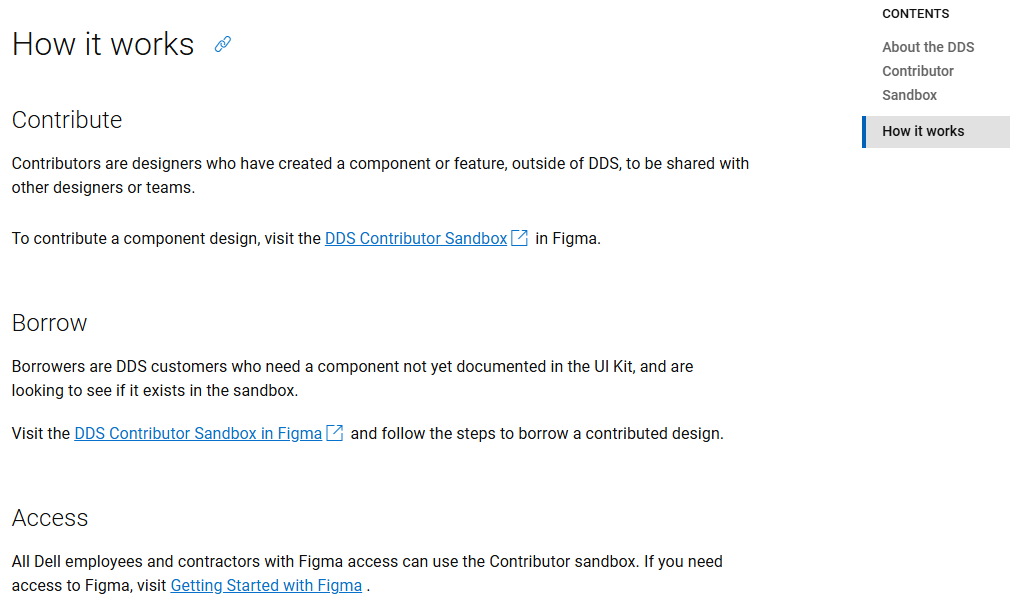
I created step‑by‑step workflow documentation that guided contributors from initial component proposal to final system adoption. This included:
Submission criteria
Required artifacts (Figma files, rationale, usage examples)
Stakeholder roles and responsibilities
Expected outcomes at each stage
This clarity reduced ambiguity and made the process predictable for both designers and engineers.
Approach
4. Integrating contributions into the documentation site
Once components were approved, I managed their integration into the design system’s documentation website. I ensured each component followed established patterns, maintained clarity, and supported decision‑oriented guidance, helping users understand not just how to use a component, but why.
Approach
2. Creating a company‑wide communication strategy
Rolling out a new contribution model required more than documentation; it required organizational alignment. I developed a communication strategy that introduced the model to over 300 designers, content designers, and engineers, ensuring they understood:
Why the model existed
How to use it
How it improved adoption
This drove early adoption and reduced friction across teams.
Outcome
Within the first week of launch, the contribution model received three qualified design submissions. Within the first month, two of these were adopted into the design system. This validated the model’s adoption method and scalability, demonstrating its impact on both system health and trust.
Approach
3. Streamlining cross‑functional collaboration
I partnered closely with engineering leads, the design system team, and product designers to ensure the contribution model worked across disciplines. Together, we aligned on:
Coding standards for new components
Review checkpoints
Documentation requirements for final system inclusion
This collaboration ensured the process was not only content‑sound but technically feasible.
Why this work matters
A design system is only as strong as its ability to evolve. By building a contribution model grounded in ease-of-use, shared tools, and cross‑functional alignment, I helped transform the design system from a static library into a living, collaborative ecosystem. This work not only improved the quality of contributions but also strengthened trust in the system across the organization.